Category: Archaeology

Gortina di Creta nel IV e nel VII secolo d.C.

Lunedì 11 e mercoledì 13 aprile 2011 si sono svolti a Padova e a Siena due seminari su Gortina di Creta nel IV e nel VII secolo d.C., nell’ambito delle rispettive scuole di dottorato in archeologia. Gli incontri erano aperti agli studenti ma hanno avuto come scopo principale quello di agevolare la presentazione dei risultati più recenti delle ricerche in corso e la discussione dei temi più rilevanti per l’agenda della ricerca a Gortina.

Questi due seminari facevano seguito a quello del 2009 sullo studio della ceramica tenuto a Milano, e dovrebbero essere seguiti nell’autunno 2011 da un seminario sull’VIII secolo, a Bologna.

Il IV secolo (de ruptura)

A Padova le presentazioni hanno trattato il teatro del Pythion e l’area antistante (successivamente occupata dal quartiere bizantino), oltre ad una panoramica più ampia sull’area del Pretorio e del complesso santuariale del Pythion tra età tardo-ellenistica e tardoantica.

Il punto più importante, che emerge con chiarezza dalle tre aree di scavo qui presentate, è che già dall’inizio del IV secolo si hanno chiari segni di abbandono del complesso santuariale del Pythion (tempio, teatro, stadio) che occupa l’intera area monumentale antica (in pratica, quella oggetto di studio della Scuola Archeologica Italiana). Il terremoto del 365 d.C. andò quindi a colpire un insieme di edifici già in corso di degrado, riutilizzati per stabulazione di animali (questa non deve essere necessariamente intesa come una attività “povera” ‒ in particolare per quanto riguarda i cavalli uccisi dal crollo del teatro) e recupero di materiale da costruzione.

Il VII secolo (de continuitate)

A Siena abbiamo trattato il VII secolo, che è il tradizionale momento di “rottura” nelle periodizzazioni della vita della città, in particolare in virtù del sisma dell’anno 670 d.C., che avrebbe posto bruscamente fine ad una precedente situazione di relativo ordine urbano. Di fatto, sono invece ormai molti gli indizi che invece fanno intuire una prosecuzione della forma urbana, almeno in alcune aree della città, legate al potere religioso o civile. La necessità di affinare gli strumenti di analisi e datazione per il periodo tardo è stata sottolineata, pur con la difficoltà legata ad un panorama mediterraneo completamente cambiato: assenza di ceramiche sigillate, volume del traffico in anfore drasticamente ridotto, tendenza dei centri urbani ad una progressiva autarchia basata sul proprio territorio (in alcuni casi, senza successo sul lungo termine come a Gortina).

Ossessione, identità, stratigrafia

L’archeologia ha/è l’ossessione del tempo che scorre. Vedere il passato, il susseguirsi dei fatti, guardando nel presente oggetti immobili, inutilizzati.

L’archeologia ha a che fare con l’identità, l’identificarsi in qualcun altro, in un altro tempo-luogo, facendolo temporaneamente, lucidamente e in maniera ripetitiva. L’archeologia è teatro.

La strati-grafia va intesa come tutte le altre –grafie artistiche e creative: una forma di composizione con sue regole ma intimamente bisognosa di un atto creativo: strati– è lo strumento utilizzato per la –grafia.

Barriere fluide tra sistemi di gestione della conoscenza in archeologia

Il 3 febbraio 2011 ho partecipato al seminario “Lo scavo e il web 2.0. Percorsi/pratiche/riflessioni” organizzato presso il mio dipartimento a Siena da Marco Valenti ed Enrico Zanini. L’idea era quella di avere una serie di interventi lampo sul tema, affrontato dalle diverse prospettive che caratterizzano i gruppi di ricerca attivi nei diversi ambiti cronologici (in particolare tarda antichità e alto medioevo) e geografici (Toscana, Mediterraneo).

Di fatto il risultato è stato un po’ diverso, un po’ più “convegno”, ma non sono comunque mancati gli spunti di riflessione.

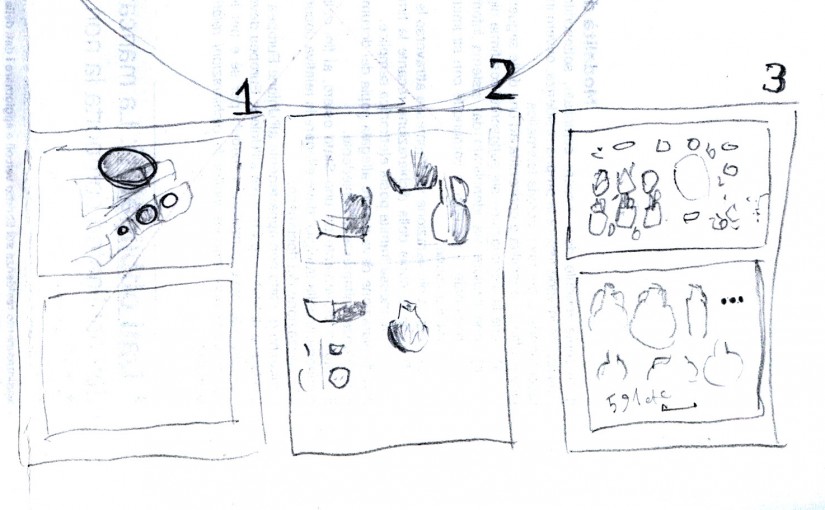
Io ho fatto un intervento di taglio molto riflessivo e autocritico (forse troppo?), la cui unica illustrazione era la seguente:

Barriere fluide tra sistemi di gestione della conoscenza

Di fatto il problema che mi sono posto e che ho condiviso con gli altri partecipanti era il seguente: già ad oggi non abbiamo le risorse per gestire “in casa” tutti i dati che produciamo, e ci affidiamo in modo crescente a servizi esterni per la gestione di video, immagini, discussioni, dati. Quanto dovrebbe essere sotto il nostro diretto controllo? Cosa può tranquillamente essere gestito tramite servizi gratuiti o a pagamento? Abbiamo riflettuto sul cloud computing e valutato la possibilità di farne uso? Abbiamo più bisogno di contenitori o di elaboratori?

Credo che la cosa più importante non sia tanto scegliere, ma avere la concreta possibilità di scegliere in ogni momento il modo più consono alle nostre esigenze e risorse, con il minimo attrito nel passaggio da un sistema all’altro. Ecco quindi che il wiki, al di là di tutte le sue carenze (di fatto, una sola: non essere un database relazionale), ha il grande vantaggio di essere già in rete, e di essere quindi naturalmente predisposto ai collegamenti da e verso l’esterno. La carenza più significativa che individuo in questa fase è semmai il fatto che i nostri wiki sono chiusi (per una serie di ragioni, alcune valide, altre superabili) e quindi viene meno la possibilità di usare i motori di ricerca, di linkare i contenuti dall’esterno, e così via.

Il video con il mio intervento e una parte della discussione successiva si trova qui, grazie al Mediacenter di Archeologia Medievale.

Voi, come usate il web 2.0 e quali barriere date all’informazione?

Legacy archaeological data and storage devices

I found a CD and a floppy disk inside one of the lockers in our laboratory:

Legacy archaeological data and storage devices

They are from 8 years ago, and they contain data about the ceramic finds from the 2003 campaign in Gortyna. This looked like a very interesting finding, from two related points of view:

  1. legacy storage devices;
  2. legacy data formats.

Storage devices

Nowadays, only certain desktop PCs are equipped with a floppy disk reader, and normal laptops are missing it since 2004 at least. I verified that the content of the floppy disk and that of the optical disk were exactly the same. My colleague made a good choice then, when she decided to backup the content of the floppy disk to the CD-R. With the exception of netbooks and tablets, all computers have an optical drive for CDs and DVDs, and they are probably going to have one for a long time.

On the other hand, optical disks are the least resistant medium for digital archiving. Good quality CDs have an average life of 10–15 years, if they are stored properly and never taken out of their case. This specific disk was manufactured by TDK, that’s a good quality manufacturer generally speaking. Magnetic disks (like 3.5″ floppy disks) can last much longer, if they are kept away from electromagnetic sources (e.g. a TV, radio, PC, electric cables in general). Magnetic tape is generally considered the most safe archival medium, but it’s not available to common users.

Whatever storage medium is chosen, the true difference is actually made by the long-term archival strategy of your team or (better) institution. Having regular backups at secure and distant locations is perhaps easier nowadays with cloud providers like Dropbox and Ubuntu One, but a research institution should (must?) be able to define its own archival strategy under full control of its own staff. What I see in a lot of universities is instead a team-wise scale for long-term storage of digital archives, with a diversity of approaches. I’ve written elsewhere about existing general recommendations, and it’s no surprise that all of them are from the UK, Germany or the EU.

Data formats

As for storage devices, the issue of data formats is two-fold:

  • the digital formats in which information is stored;
  • the way information is structured.

Digital formats are well known and usually associated with file extensions, such as .jpg for JPEG images, .odt for Open Document text files and so on. Open formats are better than proprietary, especially in the light of digital preservation. Some formats are nevertheless so widespread that it’s impossibile to to avoid them, if not for yourself from your colleagues. This is the case of Microsoft Office file formats.

The data I found on the CD are in a Microsoft Excel spreadsheet (.xls extension). Apart from that, it’s just a table that could have been saved in any other format, including a plain-text comma-separated values file (.csv) or inside a relational database. With this I mean that one thing is the format in which data is translated into bits on a machine, and another thing is how information (or data, if you prefer) is structured inside a file or any other container, and also how much it is actually structured.

Let’s take a look at this dataset then. As common in spreadsheets, there are three separate sheets:

  • drawings catalogue;
  • fabrics catalogue;
  • general catalogue of all diagnostic sherds.

The third one is the main table and contains more than 660 entries from 59 contexts. It also has pointers to the two previous tables, so this should have been a relational database if it was done right. Or not. A relational database made in 2003 would have been either Microsoft Access or FileMaker (still two incredibily popular choices). In both cases, recovering data if you don’t own a copy of the software is almost impossible. Then? Hooray for relational databases in spreadsheets! In other words, always try to use formats that can be accessed by a variety of programs, and leave the logic of your data inside the data themselves instead of assuming that other people will be able to infer them by means of conventional knowledge.

I was able to recover the entire archive and it’s now being integrated into our current documentation system.

In volo

Il cambiamento avviene ai margini, in periferia, ai confini. Non avere una identità definita, prescritta, è una condizione privilegiata. Non mi dispiace essere sempre a metà strada, sempre in discussione, mai precisamente pertinente.

Sono anarchico. Vedo e sento i miei coetanei parlare sempre al passato, con il rimpianto di non avere qualcosa di scontato ad aspettarli: un lavoro, una famiglia. Non sento mai parlare di “quello che faremo”, “voglio fare così”, perché c’è sempre qualcun altro che ti dice cosa fare, come fare. Questo è il precariato. Parlare di politica è sempre lamentarsi, e mai proporre, pianificare, cambiare le cose. Come se la realtà fosse impossibile da manipolare e l’unica possibilità sia quella di allinearsi a qualche idea già fatta e pronta. Un partito, una petizione, e mai un sogno, un progetto.

Non do niente per scontato. Non penso che sia ovvio e necessario che gli altri supportino quello che faccio, che sia degno di ricevere attenzione, denaro. Se mi chiedete cosa faccio, o perché lo faccio, non ho la risposta pronta, preconfezionata. Cerco sempre di capire a cosa serve.

Penso che l’archeologia abbia molto a che fare con il teatro, con l’identità. Plasmiamo identità per chi non ha tempo di farsene una da sola. L’importante è capire quando si è sul palcoscenico. L’importante è non cadere dal palco.

Museo archeologico di Portoferraio

Il museo civico archeologico di Portoferraio ospita reperti provenienti da tutta l’isola d’Elba e da alcuni relitti delle acque circostanti.

Roman pottery from archaeological excavations on Isola d'Elba

Fortunatamente è stato possibile scattare fotografie all’interno, anche se naturalmente la qualità non è molto buona. Purtroppo non esiste un catalogo, anche se il materiale è in gran parte pubblicato.

Scavando a Vignale, un sito di età romana di fronte all’isola d’Elba, la visita era in qualche modo un dovere. La collezione di ceramiche ellenistiche e romane è ampia: sono particolarmente interessanti i rinvenimenti subacquei e quelli degli scavi nelle villae maritimae dell’isola, come la villa delle Grotte.

A look at pollen data in the Old World

Since the 19th century, the study of archaeobotanical remains has been very important for combining “strict” archaeological knowledge with environmental data. Pollen data enable assessing the introduction of certain domesticated species of plants, or the presence of other species that grow typically where humans dwell. Not all pollen data come from archaeological fieldwork, but the relationship among the two sets is strong enough to take an interested look at pollen data worldwide, their availability and most importantly their openness, for which we follow the Open Knowledge Definition.

The starting point for finding pollen data is the NOAA website.

The Global Pollen Database hosted by the NOAA is a good starting point, but apparently its coverage is quite limited outside the US. Furthermore, data from 2005 onwards aren’t available via FTP in simple documented formats, but are instead downloadable as Access databases from another external website. Defining MS Access databases as a Bad Choice™ for data exchange is perhaps an euphemism.

Unfortunately, a large number of databases covering single continents or smaller regions is growing, and the approaches to data dissemination show marked differences.

Americas

For both North and South America, you can get data from more than one thousand sites directly via FTP. There are no explicit terms of use. Usually, data retrieved from federal agencies are public domain data.

The README document only states NOTE: PLEASE CITE ORIGINAL REFERENCES WHEN USING THIS DATA!!!!!. Fair enough, the requirement for attribution is certainly compatible with the Open Knowledge Definition.

Europe

From the GPD website we can easily reach the European Pollen Database, that is found at another website tough (and things can be even more confusing, provided that the NOAA website has some dead links).

You can download EPD data in PostgreSQL dump format (one file for each table, with a separate SQL script create_epd_db.sql). Data in the EPD can be restricted or unrestricted. That’s fine, let’s see how many unrestricted datasets there are. Following the database documentation, the P_ENTITY table contains the use status of each dataset:

steko@gibreel:~/epd-postgres-distribution-20100531$ cat p_entity.dump \
 | awk -F "t" {' print $5 '} | sort | uniq -c
 154 R
 1092 U

which is pretty good because almost 88% of them are unrestricted (NB I write most of my programs in Python but I love one liners that involve awksort and uniq). We could easily create an “unrestricted” subset and make it available for easy download to all those who don’t want to mess up with restricted data.

But what do “unrestricted” mean for EPD data? Let’s take a more careful look (emphasis mine):

  1. Data will be classified as restricted or unrestricted. All data will be available in the EPD, although restricted data can be used only as provided below.
  2. Unrestricted data are available for all uses, and are included in the EPD on various electronic sites.
  3. Restricted data may be used only by permission of the data originator. Appropriate and ethical use of restricted data is the responsibility of the data user.
  4. Restrictions on data will expire three years after they are submitted to the EPD. Just prior to the time of expiration, the data originator will be contacted by the EPD database manager with a reminder of the pending change. The originator may extend restricted status for further periods of three years by so informing the EPD each time a three-year period expires.

Sounds quite good, doesn’t it? “for all uses” is reassuring and the short time limit is a good trade off. The horror comes a few paragraphs below with the following scary details:

  1. The data are available only to non-profit-making organizations and for research.

Profit-making organizations may use the data, even for legitimate uses, only with the written consent of the EPD Board, who will determine or negotiate the payment of any fee required.

Here the false assumption that only academia is entitled to perform research is taken for granted. And there are even more rules about the “normal ethics”: basically if you use EPD data in a publication the original data author should be listed among the authors of the work. I always thought citation and attribution were invented just for that exact purpose, but it looks like they have distinctly different approach to attribution. The EPD is even deciding what are “legitimate” uses of pollen data (I can hardly think of any possible unlegitimate use).

Africa

You write “Africa” but you read “Europe” again, because most research projects are from French and English universities. For this reason, the situation is almost the same. What is even worst is that in developing countries there are far less people or organizations that can afford buying those data, notwithstanding the fact that in regions under rapid development the study and preservation of environmental resources are of major importance.

Data are downloadable for individual sites using a search engine, in Tilia format (not ASCII unfortunately). The problems come out with the license:

The wording is almost exactly the same as for the EPD seen above:

Normal ethics pertaining to co-authorship of publications applies. The contributor should be invited to be a co-author if a user makes significant use of a single contributor’s site, or if a single contributor’s data comprise a substantial portion of a larger data set analysed, or if a contributor makes a significant contribution to the analysis of the data or to the interpretation of the results. The data will be available only to non-profit-making organisations and for research. Profit-making organisations may use the data for legitimate purposes, only with the written consent of the majority of the members of the Advisory board, who will determine or negotiate the payment of any fee required. Such payment will be credited to the APD.

Conclusions

As for dendrochronological data, there is a serious misunderstanding by universities and research centers of their role in society as places of research, innovation that is available for everyone. In other words, academia is a closed system producing data (at very high costs for society) that are only available inside its walls, but it’s all done with public money.

The only positive bit of the story, if any, is that these datasets are nevertheless available on the web, and their terms of use are clearly stated, no matter how restrictive. It would be just impossible to write a similar article about archaeological pottery, or zooarchaeological finds.

Appendix: Using pollen data

Pollen data are usually presented in forms of synthetic charts where both stratigraphic data and quantitative pollen data are easily readable. Each “column” of the chart stands for a species or genus. You can create this kind of visualization with free software tools.

The stratigraph package for R can be used for

plotting and analyzing paleontological and geological data distributed through through time in stratigraphic cores or sections. Includes some miscellaneous functions for handling other kinds of palaeontological and paleoecological data.

See the chart for an example of how they look like.

An example plot using the R stratigraph package

Castori e Cultura Materiale

E per finire, che dire dei castori che costruiscono dighe modificando l’ambiente per un beneficio non immediato (cibo e tane sicure)? Hanno un progetto? Le dighe sono manufatti? Come avviene la trasmissione del sapere tecnico fra i castori?


Forse queste sono solo provocazioni prive di risposta e le dighe non sono certo fatte con le mani, ma possono divenire spunti utili per ragionare su cosa significhi l’adozione delle tecniche…

Enrico Giannichedda, Uomini e cose, 2006.

Al castello di Bogli

Oggi ho fatto una escursione al castello di Bogli. La camminata non è brevissima e la strada è interrotta in alcuni punti, rendendo il tragitto poco agevole.

Del castello non c’è praticamente niente, se non qualche cresta di muro visibile in superficie. “Castello” è forse eccessivo come denominazione, viste le piccole dimensioni penso si tratti di una torre a controllo del fondovalle. La postazione è costruita su un tratto del pendio naturalmente rialzato, e in più c’è un ampio fossato scavato artificialmente nella roccia sul versante a monte.

Qualche “genio” ha pensato bene di scavare qui un paio di buche alla ricerca di tesori, senza rendersi conto che in queste torri di avvistamento stavano disgraziati di infima classe sociale, costretti a passare interi inverni isolati, senza alcun tipo di comfort né tanto meno di oggetti preziosi.

Ho scattato un autoritratto commemorativo:

Autoritratto